How Much Do Estate Sale Companies Charge, and What Comes Out Before the Family Gets Its Check?
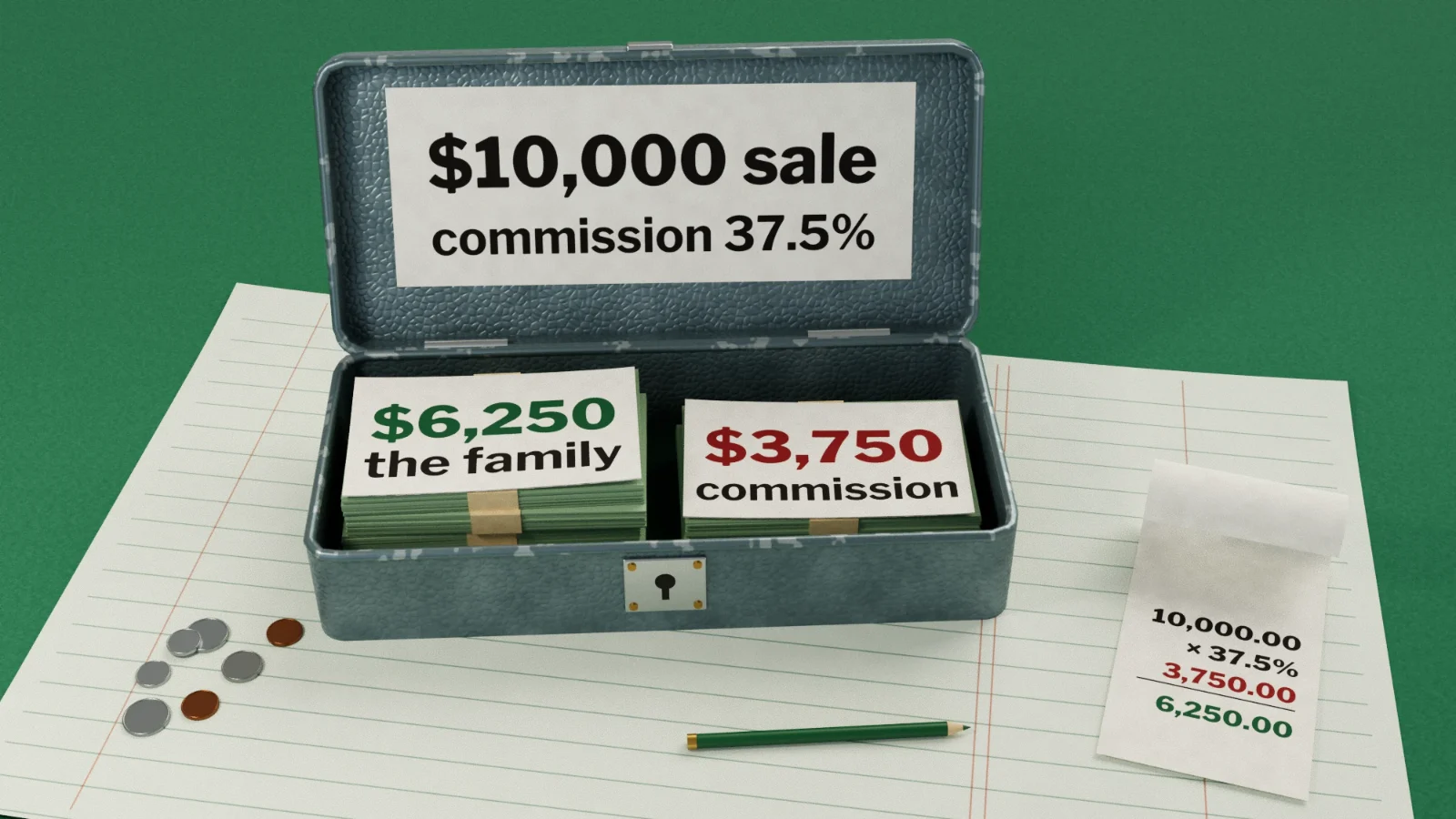
What companies post as their rate, what a minimum, the extras and the clean-out leave of a sale, when the check comes, and twelve lines for the contract.
Estate sale companies that publish a rate charge about 37.5% of what sells: that is the middle one of 53 posted rates, and the middle half of the 53 sits between 35% and 40%.
Nine in ten companies that hold sales in the house post no estate sale commission (the census, read November 24, 2026), so the 53 are the ones willing to say, not a sample.
The rest of the contract can move the check more than the rate does. Kathy Dubs, who owns Kathy’s Estate Sales in Phoenix, prints a minimum beside hers: “My minimum charge is $3,000 to conduct a sale. Standard commission is 40%.” On a small sale the minimum is the fee.
So when somebody quotes you a percentage, ask what your check would be at $5,000. Out come the minimum, the fees and the steps, while you can still say no.
The smaller the sale, the steeper the fee
Push the cash box: downhill is a smaller sale. The ground is the share the family keeps.
$3,000 to the company, 60%
- $7,500 the minimum takes over
- $3,000 the minimum takes everything


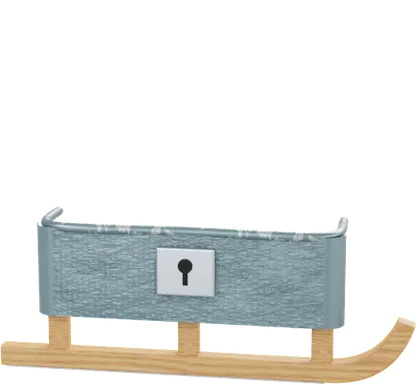
$2,000 to the family, 40%
Of a $5,000 sale the $3,000 minimum is more than 40%, so it is the fee: 60% of the sale. The family keeps $2,000.
Where this ground breaks: at $7,500, the minimum takes over; at $3,000, the minimum takes everything.
What percentage do estate sale companies take?
The commonest single figure is 40%, at twelve of the 53.
Those twelve are among the 21 companies that post one number. The other 32 post a range, most often 35 to 50%. Counted by the low ends the middle is 35%; by the high ends, 40%. In Texas only eight companies post a rate, and four of them say 40%.
Every posted rate, in one crowd
37.5% the middle one
- 30% two companies
- 35% seven companies
- 40% twelve companies
- 10 to 20% one company
- 20 to 25% one company
- 20 to 40% two companies
- 25 to 35% three companies
- 25 to 40% one company
- 30 to 35% two companies
- 20 to 50% one company
- 30 to 40% four companies
- 35 to 40% four companies
- 30 to 50% two companies
- 35 to 50% nine companies
- 40 to 45% one company
- 40 to 50% one company
Slide the weight to the rate you were quoted.
A range can be a remark about your house: one company near Los Angeles typically runs from 20% to 50%, by the labor the house takes and what its average piece is worth.
Ask for a lower rate on the few things that would sell with nobody’s help. All American Tag Sales, on Long Island, prints its own: 10% on gold jewelry, 20% on sterling flatware and vehicles, 10% on a single artwork that brings $5,000 or more. A $9,000 car at 20% instead of 40% is $1,800 that stays in the family.
How much do estate sale companies charge on $5,000, $10,000 and $20,000?
The smaller the sale, the bigger the share that goes.
On $5,000 the charge runs from $1,875 to $4,275 on the five sets of terms below. What the family keeps of each, by our arithmetic:
- The middle rate, 37.5%: $3,125, $6,250 and $12,500.
- A flat 40%: $3,000, $6,000 and $12,000.
- 40% or the $3,000 minimum, whichever is larger: $2,000, then the same two. The minimum stops biting at $7,500.
- Steps: the Long Island company takes 50% up to $9,999.99, 40% from $10,000 and 35% from $20,000, which leaves $2,500, $6,000 and $13,000.
- Packages: under $8,000 a company in Orange County, California, takes 50% plus a $1,100 service fee and $675 a load, then 45% and the loads to $15,000, then 40%. With one load at the first two: $725, $4,825 and $12,000.
Look twice at the steps. At $9,999 the family keeps just under $5,000, at $10,000 it keeps $6,000, and the last dollar through the cash box is worth a thousand. Ask for the running total every evening, as Minnesota’s attorney general tells families to.
What fees come on top of the estate sale commission?
Sometimes none; otherwise advertising, set-up labor, card fees, hauling and the clean-out.
Nothing is due up front, say 104 companies. A company near Los Angeles generally asks 30%, with advertising and labor on top, and a flat 40% is cheaper once those two pass a tenth of the sale.
Put three printed figures in one contract, the 37.5%, a $250 advertising fee and a New Jersey company’s typical clean-out, about $2,500, and a $10,000 box empties like this.

What leaves the box first
- $10,000 the sale brought
- $3,750 commission, 37.5%
- $250 advertising fee
- $2,500 clean-out
- $3,500 the family
Left for the family: $3,500 of $10,000. Of the $6,500 that left, 58% was commission.
Are estate sale companies worth it?
It turns on the bill for emptying the house, which comes anyway.
Printed prices run $1,000 to $5,000 in San Diego, often $500 to $6,000 in New Jersey and $1,500 and up in North Carolina.
Say your hauler wants $2,500. Timber & Trust, in Montana, takes 40%, standard clean-out and donation hauling included. On a $10,000 sale that leaves $6,000 and an empty house, and the hauler alone leaves you $2,500 poorer, so the two are $8,500 apart by our arithmetic. Run your own numbers.
It goes wrong when there is no time, or when the good things have gone home with the cousins. Bryan McDaniel, who founded ezDownsizing in northern Virginia, says consultants too often “show up to find the closets and dressers empty.” Other ways out:
- Sell the contents in one go. Yahnn Kraveichvili, who founded San Diego Liquidation and Estate Services, has a rule of thumb of about 60% of resale value, hauling and cleanup included, because “we take on the work and the risk.” A 40% commission leaves 60% too, but of what shoppers paid.
- Run it yourselves. EstateSales.org takes families’ own sales, at a base price of $50.
What should an estate sale contract say?
Who gets what, on which day, out of whose account, and what becomes of the rest.
From the price tag to your check

- What the tags say the marked prices
- Markdowns and offers last day half off at 34 of 55 that say
- Money collected the base of the percentage
- Sales tax left out of the base at one company
- Card fees 3% at one online-auction company, 60% of it the seller's
- Commission 37.5%, the median
- Minimum $3,000: the fee on any sale under $7,500, at 40%
- Extras $250 advertising; $1,100 service fee
- Clean-out $500 to $6,000 where printed
- Things taken back commission may still run
- What is left 182 of 287 donate, 174 haul, 25 consign, 19 buy, 17 hand back
- Whose account escrow by rule in Arkansas
- Days 7, the median of 100 companies
- Your check and the item list
Twelve lines decide it, and the estate sale commission is half of the first one. If you want a form to start from, Arkansas’s rules list what a contract there must hold. Minnesota’s attorney general warns that a promise not written into the contract may not be kept.
- The base, and what comes on top: a percentage of what your things brought, with sales tax out of it, then every extra, with a ceiling.
- The minimum, with a lid: whether the fee can pass what the sale brings. McDaniel’s page warns that a family can end up owing $2,000.
- Things you take back: a keep-list, because at a Georgia company taking something out after signing may cost you the commission on it.
- Prices: how much comes off on which day, and what can’t be cut without a call.
- Who else buys, and who else sells: staff only with your written consent, and nobody else’s goods in the house.
- Where the money sleeps: in its own account, as at an Illinois company that writes the check from escrow.
- The date, and the price of missing it: Timber & Trust drops its 40% to 30% if the house isn’t empty and broom-clean by day 21. Ask for the same on your money.
- The statement: every item or group, its tag, what it brought, and the card and check records.
- What is left: who decides, by when, a list before anything leaves, and whether “broom-clean” takes in the attic, the garage and the paint cans.
- What is found: cash, jewelry and papers, logged and handed over. Once they have left inside a sold desk a court may be deciding.
- Loss, and who stands behind it: a Michigan company leaves loss and injury to your homeowner’s policy unless it was negligent. One in Georgia says its policy also covers the things it was hired to sell.
- The way out: what it costs either side to cancel. The federal three-business-day rule for many services signed for at home never mentions estate sales, so write your own.
Which of the twelve lines are in your contract?

Example, not a real contract
Estate sale agreement between Company and Client.
1. Company will keep 40% of gross sales as its commission, with a minimum fee of $3,000.
2. Advertising ($250) and credit card processing fees will be deducted from Client's share.
3. Client will not remove any item after signing; commission is due on any item removed, at Company's appraised value.
4. Company may reduce prices at its discretion on any day of the sale.
5. Company will mail Client a check within 10 business days of the last day of the sale.
6. Items not sold become the property of Company unless Client removes them within 24 hours.
7. Company is not responsible for loss, theft or breakage. Company is bonded and insured.
8. If Client cancels, Client will pay Company's expenses to date and a fee of $500.

We found 8 of the 12 lines in it. We did not find who else buys and sells, where the money sleeps, the statement, and things found in the house.
The company takes 40% of gross sales. We found nothing that leaves sales tax out. On top of that: advertising ($250) and credit card processing fees.
The minimum is $3,000. At 40%, it decides your cost on any sale under $7,500. We found nothing that stops the fee from being more than the sale brings in.
On things you take back it says: “commission is due on any item removed, at Company's appraised value.” The company sets the value it charges on.
Ask: If we keep something after signing, what do we owe you? May we attach a list, room by room, of what stays?
On prices it says: “Company may reduce prices at its discretion on any day of the sale.” At its discretion means no floor, and no call to you.
Ask: How much comes off on which day, and which items need a call to us first?
We did not find a line on staff buying, or on other people's goods in the house.
Ask: Do you or your staff buy from the sale, and will anything that isn't ours be sold in the house?
We did not find where the money is kept.
Ask: Is our money kept in an account of its own until we are paid?
You are paid within 10 business days. Ten business days is two weeks. After a sale that ends on Sunday, December 6, 2026, that is Friday, December 18. We did not find a penalty if it is late.
We did not find a promise to list what sold.
Ask: With the check, will we get a list of what sold, what its tag said and what it brought, with the card and check records?
What doesn't sell: “Items not sold become the property of Company unless Client removes them within 24 hours.” On those terms it becomes theirs.
Ask: Who decides what happens to what doesn't sell, by when, and who pays to move it? May we see a list before it goes?
We did not find a line on cash, jewelry or papers that turn up in the house.
Ask: If you find cash, jewelry or papers, will you list them and hand them to us?
On loss it says: “Company is not responsible for loss, theft or breakage.” The loss is yours, so ask for their certificate and call your insurer. It says it is bonded and insured. We found no number, no amount and nobody named who can confirm it.
Ask: If something is stolen or broken, or someone is hurt, whose insurance pays? What license, bond and policy do you hold, in what numbers and amounts, and who can confirm them?
To leave: “If Client cancels, Client will pay Company's expenses to date and a fee of $500.” We found a cost for you to leave, and none for them.
Ask: What does it cost either of us to cancel or move the sale?
In Arkansas the board's rules want the date, the sale's day, time and place, special terms, the commission, other expenses and signatures in the contract, the money in escrow, and settlement within ten business days. (Arkansas Auctioneer Licensing Board Rules, read November 24, 2026.)
In Illinois a sale run for pay, advertised for a set time, open to the public, with goods bid on or negotiated, takes a licensed auctioneer. Ask for the license number. (Estate Sale FAQ, read November 24, 2026.)
In Minnesota a bond of at least $20,000 must be on file with the county before this contract is made. Ask which county, and call its treasurer. (Minnesota Statutes 325E.70, Estate sale conductors; bonding required, read November 24, 2026.)
Ask the state consumer office whether a company that sells priced goods in a home for a fee needs a license, a bond or a permit there. (State consumer protection offices, read November 24, 2026.)
How long does it take to get paid after an estate sale?
Within a week, at half of the 100 companies that give a number.
Most promise it in ten days, but about half count business days. After a sale that ends Sunday, December 6, 2026, about three-quarters fall due by the tenth day, and one company’s 20 business days reach January. If no check comes, step 6 below holds anywhere.
Ten days is not always ten days
The sale ends and the contract pays : .
Within 10 business days of Sunday, December 6, 2026 is Friday, December 18: twelve days. Of 100 companies that give a number, 87 promise the check by then.
| Sun | Mon | Tue | Wed | Thu | Fri | Sat |
|---|---|---|---|---|---|---|
| Dec 6 | 7 | 8 | 9 | 10 | 11 | 12 |
| 13 | 14 | 15 | 16 | 17 | 18AR | 19 |
| 20 | 21 | 22 | 23 | 24 | 25 | 26 |
| 27WA | 28 | 29 | 30 | 31 | Jan 1 | 2 |
| 3 | 4 | 5 | 6 | 7 | 8 | 9 |
- counts days counts business days your check
- AR Arkansas, estate sales and auctions: by Friday, December 18
- WA Washington, auctions, unless agreed otherwise in writing: by Sunday, December 27
Auction clients get their dates from the law. Washington gives them an accounting and their money within 21 calendar days, unless both agreed otherwise in writing, with what isn’t paid in 24 hours in a trust account by the next business day. North Carolina gives them a signed statement of everything sold. A tag sale family mostly has the contract, so borrow those lines.
The sheet that comes with the check
Example, not a real sale
| Sold | The tag | Brought |
|---|---|---|
| Dining table, six chairs | $600 | $480 |
| Two bedroom sets | $900 | $700 |
| Tools, garage, 62 pieces | $880 | $760 |
| Kitchen and glass, 210 pieces | $900 | $640 |
| Jewelry, 48 pieces | $520 | $430 |
| Rugs, three | $600 | $450 |
| Books, records, linens, 340 pieces | $700 | $490 |
| Lawn and patio | $500 | $400 |
| Sofa | $350 | $250 |
| Everything under $10, by the day | $400 | |
| Collected, sales tax apart | $5,000.00 | |
| Commission | $2,000.00 | |
| Minimum, less the commission | $1,000.00 | |
| Net to the family | $2,000.00 | |
Card and check records attached
CompanyFamily
What has to be on it
- What the tag said, beside what it brought. Our own line.
- Each thing sold, and its price. North Carolina Auctioneer Information for Consumers Brochure.
- The total collected, sales tax apart. Our own line.
- $1,000: the minimum, less 40% of $5,000. Our own line.
- The net, who was paid, how much. North Carolina Auctioneer Information for Consumers Brochure.
- Card and check records behind it. Avoid Estate Sale Scams.
- Signed by both. North Carolina Auctioneer Information for Consumers Brochure.
For inherited things the cost basis is generally their fair market value on the day the owner died, the IRS says, and only a price above it is a gain. (One exception is an executor’s estate tax return that elects the alternate valuation date. This is not tax advice.)
Do you need a license to have an estate sale?
Not to sell your own things, in the three states below.
A company there may need a license or a bond (all read November 24, 2026):
- Arkansas. Anyone who runs an estate sale there must be licensed by the auctioneers’ board, since August 1, 2023. Its rules want a written contract, escrow and settlement in ten business days.
- Illinois. Since January 1, 2026, some sales need a licensed auctioneer. All four must be true: the sale is for somebody else for pay, advertised for a set date and time, open to the public, and the goods are bid on or negotiated. Owners, beneficiaries and executors are outside it.
- Minnesota. The company files a surety bond of at least $20,000 with the county before the contract is made. The county treasurer’s office can confirm it.
In four more states the license is about bidding: Texas, Virginia, Washington and North Carolina. In Texas an auction is a sale by competitive bid, and estate sales are never mentioned. North Carolina names the estate sale too, as a liquidation “by sale at auction.” California licenses no auctioneer but wants a $20,000 bond on file. Other states differ. If yours isn’t here, ask its consumer office whether selling priced goods in a home for a fee takes a license, a bond or a permit.

That leaves you to tell a company from a person with folding tables, and the test is whether anybody else can confirm a word of it. Of the 118 that say licensed, 32 name who, what or a number. A city may want a permit as well, and none of this is legal advice.
How do you choose an estate sale company?
Call three, ask each the same eight questions, and lay the answers side by side.
- “If the sale brings $5,000, what is my check? And at $10,000?”
- “What did your last three sales bring, and what had you told those families to expect?”
- “If my sister takes the piano after I sign, what do I owe you?”
- “Who will be in the house, and do any of you buy?”
- “Sunday night, whose account is the money in?”
- “What date is my check, and what comes in the envelope with it?”
- “Monday morning, what’s still in the house, and who pays to move it?”
- “What license, bond and policy do you have, in what numbers, and who besides you can confirm them?”
The commission isn’t on the list, because the first answer contains it. Call past clients, as Minnesota advises, and ask for the blank contract by email; if a firm won’t send one, McDaniel’s page says, find another.
How do you hire an estate sale company from another state?
By email, by video, and with one person you trust in the house on the last evening.
- Tonight, find the paper that says you may sell; one Georgia company wants letters testamentary or the like before it books a visit. Take home photographs and papers, and throw nothing out.
- This week, make three calls (by ZIP), get three blank contracts and phone the city clerk.
- Before you sign, walk the house by video, reading the keep-list aloud. Get their estimate of the total in an email, and work out your check at half of it.
- During the sale, get a subtotal by text each night. You may be asked to stay away; Minnesota’s attorney general says you may wish to send a neutral third party. a friend who shops needs nobody’s permission.
- The day after, your friend photographs every room, gets the keys and sees the list of what’s left before a truck does.
- If the date passes with no check, write that day for the statement and the deposit record. Then write whoever licensed or bonded them: Arkansas’s board (its recovery fund can pay up to $15,000 if the company was licensed), Illinois’s regulator, the Minnesota county with the bond. Elsewhere, the state’s consumer office. It can be a crime: a Michigan operator who kept clients’ proceeds pleaded guilty, with $77,523.21 in restitution.
How this guide was made
Researched and drafted with AI help from the sources linked above, and checked against them by a second AI reader (how we check). Corrections: our corrections page.
- Written by
- Estate Sales Near Me staff (who we are)
- Sources last read
- (how we check)
- Linked in the text
- 42 pages on 37 websites
All 37, by address
kathysestatesales.com, allamericantagsales.com, goldstandardestatesales.com, 210estateauctions.com, ag.state.mn.us, victoriasvintage.net, fullcircleestate.com, bbestatesalesnj.com, sandiegoestateservices.com, jerrysantiquesandestates.com, secondwindestateliquidation.com, timberandtrust.com, ezdownsizing.com, support.estatesales.org, estatesalesgainesville.com, colorfulcoloradoestatesales.com, donnadavisestatesales.com, labor.arkansas.gov, sheridan2inc.com, americanaestatesales.com, bulldogestatesales.com, ecfr.gov, idfpr.illinois.gov, revisor.mn.gov, usa.gov, mkestatesales.com, app.leg.wa.gov, opm.gov, ncalb.org, irs.gov, statutes.capitol.texas.gov, law.lis.virginia.gov, ncleg.gov, leginfo.legislature.ca.gov, sos.ca.gov, catalog.archives.gov, michigan.gov - Published
- This site
- Independent: sells nothing, and is paid by none of the companies it names or links to.
- Found a mistake?
- Corrections · Editorial policy


