Is Money You Find in an Estate Sale Purchase Yours to Keep? What Courts Have Held, and What to Do

In court, buying a dresser has seldom meant buying the cash hidden in it. What to do first with found money, the letter to send, and when it becomes yours.
Found money in something from an estate sale isn’t yours while its owner can be traced, unless the sale included it. So before anything else:
- Don’t spend it or bank it.
- Photograph it where it lay, and copy the serial numbers.
- Write to whoever ran the sale and say you are holding it for its owner.
- If you are the family, write tonight too: the money was never part of the sale.
Both letters are below. This is information from other people’s cases, not legal advice, and a statute where you live may change the answer.
Courts have mostly come down on the owner’s side. We read the 17 reported decisions we could find on finds like that, from 1861 to 2012. They are not a sample of disputes: they come from different states and rest on different rules, so they show how judges reason and not how yours would end. The owner’s side kept the find in 14 and the buyer in three.
In only one of the 17 had the owner given the money up, and that was drug money. Most of the rest turned on whether anyone had meant to sell what was inside, and on the sale’s words. A mattress, a bathrobe and a locked file cabinet were sold; what was in them was not. The other two winning buyers had words on their side: a safe auctioned as locked and never opened, and a contract telling the estate to take everything out.
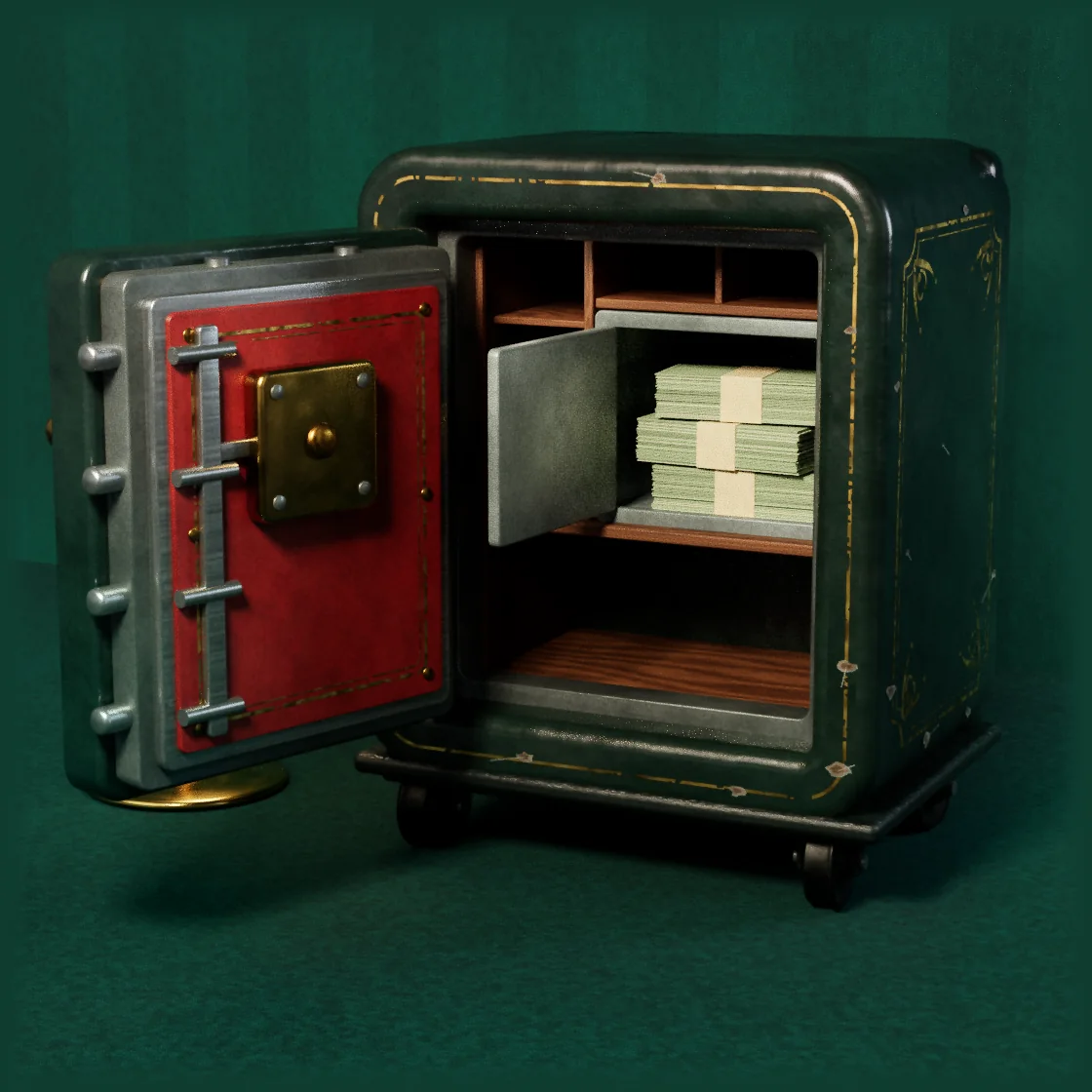
The safe below sets your own facts beside those 17 and seven decisions of two other kinds.
The safe verdict: your facts beside 24 past decisions
It opens on an example: cash hidden in furniture the family sold, nothing said, the family known. Set your own facts.

Shut: owner’s side Open: buyer
No set of answers about a known owner opens it all the way: the buyer won 3 of 17.
Fact 1 of 8: What was it in?
The door stays shut. The five nearest cases all went to the owner’s side. Nearest is a mattress bought for $2.50: gold certificates inside it (Louisiana, 1959). The heirs were awarded their face value. All seven facts are the same. No one has been told. In Kentucky and Georgia the finders who held on to it paid for it, so the letter comes first.
This sets your facts beside past cases. It predicts nothing, and a statute in your state may change the answer.
The nearest cases: the farther out, the less alike
- The mattress, Louisiana, 1959Gold certificates. The heirs were awarded their face value.Owner’s side7 of 7 the same178 F. Supp. 854
- The travel bag, Kentucky, 1936Gold certificates. The estate won, with interest.Owner’s side6 of 7 the same264 Ky. 167
- The $1.75 table, Delaware, 1906A pocketbook of money. The estate won, with interest.Owner’s side6 of 7 the same22 Del. 44
- The buried jars, Iowa, 1991Coins and paper money. The court held the last owner’s legatees own it; her estate can be reopened.Owner’s side5 of 7 the same467 N.W.2d 266
- The chimney hearth, Georgia, 1978111 gold coins. They were never produced; a jury believed in them and found for the estate.Owner’s side5 of 7 the same145 Ga. App. 420
How the door is worked out
The 24 are the 17 counted in the text, four whose owner was never found and three where the thing itself was the treasure. What the sale said and whether the owner gave it up count three times, the other five facts once; each point doubles a case’s pull on the door. A slip lies farther out for each point it falls short of 11. It is a comparison with past cases, not a prediction. The safe is a 3D illustration.Whose found money is, when you bought the thing it was in
Whoever owned it before the sale, unless the sale was meant to include it.
At an estate’s auction in Pennsylvania a man paid fifteen cents for a contraption the list called a “drill machine.” At home he split it with an axe and laid open a hidden drawer: notes, coin, two watches and a pocket compass, $3,754.50 in all. He reported it at once, and in 1861 he lost. “A sale of a coat,” the court said, “does not give title to the pocket-book which may happen to be temporarily deposited in it.”

So it went in Louisiana with a $2.50 mattress: an air blast at a mattress works blew $22,200 in gold certificates out of its cotton. The heirs were awarded their face value. The man who ran the works testified he didn’t want them.
A case is one of the 17 when something was sold, given or handed over, and then the owner’s side and a buyer or finder both claimed what was inside. Four finds whose owner never turned up, and three things that were treasures themselves, are in the pieces on this page but not in that count. Quarrels that never reached a printed opinion are in neither. A judge in 1980 counted “approximately a dozen” such reports “in over 200 years.” Everything linked here was read November 24, 2026.
Seventeen cases on one line, 1861 to 2012
Owner’s side 14
Buyer 3
objects 10 to 2 · houses and land 4 to 1
- The drill machine 1861: $3,754.50186138 Pa. 491Owner’s side
- The safe’s lining 1877: $165187711 R.I. 588Owner never found
- The waste paper 1878: $100187862 Ind. 281Owner never found
- The safe at the sheriff’s sale 1879: $434.50187934 Ark. 421Owner’s side
- The $1.75 table 1906: $58.50190622 Del. 44Owner’s side
- The travel bag 1936: $2,0401936264 Ky. 167Owner’s side
- The box of clothes 1948: $2,500194831 Tenn. App. 85Owner’s side
- The ball of rags 1948: $2,1001948253 Wis. 80Owner never found
- The mattress 1959: $22,2001959178 F. Supp. 854Owner’s side
- The engine cans 1965: $4,565196566 Wn.2d 513Owner’s side
- The house “with the contents” 1967: no amount stated1967141 Ind. App. 622Owner’s side
- The piano 1969: $4,4671969296 F. Supp. 3Owner never found
- The chimney hearth 1978: $30,0001978145 Ga. App. 420Owner’s side
- The Everett safe 1981: $32,207198195 Wn.2d 853Buyer
- The file cabinet 1985: $6,687,948.851985139 Ill. App. 3d 374Owner’s side
- The $30 dresser 1986: $150,400198669 Md. App. 97Owner’s side
- The donated silver 1989: $3,7911989187 Ill. App. 3d 603Owner’s side
- The buried jars 1991: $24,547.741991467 N.W.2d 266Owner’s side
- The fuel tank 2000: about $82,0002000119 F. Supp. 2d 1013Buyer
- The basement ceiling 2008: about $122,0002008222 Or. App. 384Buyer
- The ammunition cans 2012: about $500,0002012229 Ariz. 584Owner’s side
What the dollars are
A bigger disc is ten times the dollars. Dollars are the opinions’ own, not adjusted: the sheriff’s safe is drawn at its scrip and bonds, the engines at what the airline had paid, the certificates at their total on paper, the stamps at their advertised price and the silver at the donors’ figure. The gold coins of 1978 are drawn at the lower of two dealers’ sight-unseen minimums, $30,000; the coins were never produced and the opinion states no verdict amount.“As is” and “all sales final”
Neither makes it yours by itself: “as is” has meant the thing’s condition, and “all sales final” won once, with help.
- Illinois, 1985: a bank sold its used furniture “as is.” A locked file cabinet from the lot fell over in a garage, and out came seven certificates of deposit, already paid, totaling $6,687,948.85. “As is” meant the cabinet, the court held, and the certificates were the bank’s.
- Arizona, 2012: the appeals court held the same for a house with about $500,000 in ammunition cans in its walls.
- Indiana, 1967: a deed “together with the contents thereof” meant furnishings, not the shares and savings bonds in the dresser and books.
- Tennessee, 1948: a buyer swore the auctioneer said what you bought was yours, “regardless of what was in there.” Hers was a $9.50 box of old clothes with a $2,500 diamond ring in a bathrobe pocket, and the estate got the ring.
Eight sets of words, two that reached inside

“Bid upon it, it may contain the hidden treasure”
The crier at an estate’s auction
The drill machine, 15 cents. Pennsylvania, 1861
The court: The valuables “were not inventoried, were not exposed to auction, were not sold.” 38 Pa. 491
“Here is a box of clothes. What am I offered for it?”
The auctioneer; by the buyer’s account he also told the crowd that what you bought “was yours, regardless of what was in there”
The box of clothes, $9.50. Tennessee, 1948
The court: Terms of sale are “not to entrap them into one which they had no idea of making.” 31 Tenn. App. 85
“together with the contents thereof”
A deed
A house. Indiana, 1967
The court: Contents are “objects of furnishings and household goods as are normally found in a home.” 141 Ind. App. 622
“as is”
A bank selling used furniture
The file cabinet, free. Illinois, 1985
The court: It “does not show an intent to sell the contents of the used furniture.” 139 Ill. App. 3d 374
“used clothing”
The donors, to the charity shop
The donated silver, $15. Illinois, 1989
The court: Leaving it unknowingly “is not equivalent to a voluntary transfer.” 187 Ill. App. 3d 603
“as is”
An estate selling a house
The ammunition cans. Arizona, 2012
The court: There “was no mutual assent to sell the house with concealed valuables.” 229 Ariz. 584
The inside stayed with its owner. 6
“still locked,” “never been opened by me,” “All Sales Are Final,” and nothing held back
The auctioneer and the sign behind him
The Everett safe, $50. Washington, 1981
The court: An intent “to sell the safe and its contents.” 95 Wn.2d 853
“shall remove all personal property (including trash and debris)”
A signed contract, binding the estate
The basement ceiling. Oregon, 2008
The court: “All personal property” “unambiguously includes money.” 222 Or. App. 384
The inside went with it. 2
Hidden on purpose or swept up by mistake, the owner’s side came out ahead either way. The gap closes only where the sale spoke of the inside. Where, as reported, it said nothing of it, or “as is,” or a joke, one buyer won, and that was the drug money. Where it named the contents, a lock or what was left, two buyers won and two lost. The sorting is ours, and four cases are few.
The two wins are narrow. An Oregon estate had signed to remove “all personal property (including trash and debris)” from the house it sold, and about $122,000 above the basement ceiling was personal property it had not removed. The other was a $50 safe in Everett, Washington. Three courts opened that one.
A storage unit is sold under a law of its own. In California a good-faith buyer at a lien sale takes the goods free of the tenant’s rights. The papers still rule: in 2020 a court let a company undo an $11,800 sale about half an hour after it, under clauses the bidder had signed.
One safe, three courts
The buyers’
July 23, 1981
The buyers
State Supreme Court: reasonable people would take the auctioneer to be selling “the safe and its contents.” It came back to what was said and what was not. The buyers’ request for attorney fees was denied.
- August 12, 1978: A $50 safe. An auction in Washington State. The safe comes from an estate, and the buyers keep a secondhand store. Its outer door stands open, its inner one is locked. Nobody knows it is there.
- The same day: What the crowd was told. The safes were “from an estate,” “still locked,” and the auctioneer had never opened them and didn’t have the combinations. The inner door needed a key, and there was none. Nobody knows it is there.
- The same day: What nobody said. Nothing was held back for the estate. A sign behind the block read “All Sales Are Final.” Nobody knows it is there.
- Several days later: A locksmith. The buyers take the safe to have the inner compartment opened. Nobody knows it is there.
- The locksmith’s shop: $32,207. It is in the locked compartment. In the locksmith’s hands.
- Then: The police. The locksmith calls them and they impound the money. Held by the police.
- Then: Two claims. The estate’s representative says he “only intended to sell the safe, not the contents,” and believed it empty. The city asks a court to choose. Held by the police.
- Trial court: The estate. Summary judgment: nobody disputes the facts. The estate’s, so far.
- July 14, 1980: The estate, 2 to 1. Court of Appeals: an experienced bidder would expect an estate’s safe “had been inventoried and any contents removed.” The estate’s, so far.
- July 23, 1981: The buyers. State Supreme Court: reasonable people would take the auctioneer to be selling “the safe and its contents.” It came back to what was said and what was not. The buyers’ request for attorney fees was denied. The buyers’.
Finders keepers, and the law
The saying holds only against people who aren’t the owner. A Maryland court tried the saying in 1986, found it “legally unsound,” and held that stamps advertised at $150,400 still belonged to the collectors who had bought them. The man who found them in a $30 dresser paid the costs.
Found money with no known owner is kinder to finders, and the label matters:
- Lost, dropped without knowing: the finder holds it.
- Mislaid, put somewhere on purpose and forgotten: the owner of the place holds it.
- Abandoned, given up for good: whoever takes it.
- Treasure trove, hidden so long the owner is unknown: finders in older cases. Courts in Texas, Michigan, Tennessee and Idaho have refused it.
In your own dresser you are finder and owner of the place at once. whichever label sticks, you are likely the one holding it, for an owner who may yet turn up.
Hidden or left, mentioned or not: where 17 cases point
Outside the ring nobody knows whose it was: four names, and who holds it.
6 to 1: hidden, the inside not mentioned
- The drill machine, 1861
- The travel bag, 1936
- The mattress, 1959
- The chimney hearth, 1978
- The buried jars, 1991
- The fuel tank, 2000
- The ammunition cans, 2012
The one buyer: cash drug couriers had given up for good.
The inside not mentioned 13 of 17 lie here; 12 went to the owner’s side
Treasure trove
Hidden so long the owner is unknown: the finder in older cases; refused since.
- Finder: Oregon 1904, Indiana 1922, Iowa 1937, Wisconsin 1948
- Refused: Texas 1955, Michigan 1981, Tennessee 1985, Idaho 2001
- Idaho on the trend since 1950: “decidedly against”
- The $30 dresser, 1986, on the line
Nobody explained how the stamps got there.
5 to 0: left or mistaken, the inside not mentioned
- The safe at the sheriff’s sale, 1879
- The $1.75 table, 1906
- The engine cans, 1965
- The file cabinet, 1985
- The donated silver, 1989
Mislaid
Put somewhere on purpose and forgotten: the owner of the place, to hold for the true owner.
Hidden on purpose


Left, stored or sent off by mistake
Lost
Dropped without knowing: the finder, against everyone but the owner.
- Rhode Island safe lining, 1877: $165
- Indiana waste paper, 1878: $100
1 to 1: hidden, the inside mentioned
- The box of clothes, 1948
- The basement ceiling, 2008
The inside mentioned 4 of 17 lie here; 2 went to the owner’s side
Abandoned
Given up for good: whoever takes it.
- The Everett safe, 1981, on the line
Nobody explained how the cash got into the locked compartment.
1 to 0: left or mistaken, the inside mentioned
- The house “with the contents”, 1967
How they were sorted
Mentioned: the sale named the contents, a lock or what was left. Not mentioned: nothing said, “as is,” or a crier’s joke.When keeping found money is theft
Don’t keep it while you know, or could reasonably find out, whose it is. Keeping lost property then, with no reasonable effort to return it, is theft under statutes in California, Minnesota and Arizona. An estate sale comes with an address, a date and often a company’s name; “I couldn’t tell whose it was” starts from behind.
Where the owner truly is unknown, some states start a clock for reporting it:
- Two days: Massachusetts and, where a town has adopted the law, Connecticut.
- Five: Iowa, Illinois and Wisconsin.
- Seven: Washington and Maine.
- Ten: New York, Oregon and Idaho.
- No number given: Michigan, which says report it.
Treat two days as yours until you have read your own state’s law. Report it, and if nobody claims it, it can become yours. The wait is 60 days in Washington, 90 in Wisconsin, three months in Oregon, a year in Massachusetts and Iowa, and up to three in New York.
Then check that yours is the kind of found money the law means. Courts in Iowa, Wisconsin and Washington held that their statutes don’t reach money hidden on purpose. Florida’s covers only what was mislaid in public places or on business premises, while New York’s counts mislaid money as lost.
Money found on the ground has rules of its own in some states. Florida requires anyone who finds lost or abandoned property to report it, and treats keeping it as theft. Many other reporting laws start at a sum, from $1 in the Connecticut towns that have adopted theirs to $250 in Oregon; the state list under the first hour has each one.
What to do with found money, in order
Keep it whole, write it down, and tell the seller in writing the same day.
The first hour is for evidence. Copy serial numbers and coin dates with someone watching; an Oregon court forgave a hotel owner who had banked eight found bills, because his lawyer had listed the serials. Then shut it away from from your own money.
The first week is for finding out who may take it. The letter below asks whoever ran the sale exactly that, and the rest depends on the answer.
- Someone answers: ask for the court’s letters naming the personal representative, and hand it over against a signed receipt. Arizona protects a person who deals in good faith on letters certified within sixty days.
- Two relatives claim it, or nobody can prove it: you needn’t choose. Police or a judge can hold it, which is how Everett’s safe reached court.
- No company to ask: start at the courthouse. If the company is gone the probate court’s file names the representative, if there is one.
- No answer at all: report it where your state says and keep holding it.
- Five figures or more: see a lawyer first.
What goes wrong with found money is on record. A Kentucky couple who kept the gold certificates from a travel bag’s lining owed the money with interest. An Arkansas man “knew nothing about the matter” and referred the owner to his attorney; that counted as refusing. Two Georgia men said 111 gold coins were a hoax to impress women. The jury believed in the coins.
The first hour, from either side of the sale
I found it

What lies beside it may say whose it was: in Oregon, adding-machine tape in the owner’s handwriting. 222 Or. App. 384
Where and how it lay helps decide what the law calls it. 136 Idaho 417
In Iowa in 1937 nobody had noted the dates on the coins, and the court remarked on it. 223 Iowa 1141, 186 Or. 129
One buyer banked what he found in his own name, sent the owner to his attorney, and was held to have converted it. 34 Ark. 421
The week after
- Day 1 The letter is with whoever ran the sale, and you have a copy. Look for a name: bands, envelopes, engraving, the names printed on bonds.
- Day 2 No owner to be learned: report it where your state says. Two days is the shortest clock here. Massachusetts General Laws, chapter 134, section 1, Iowa Code 2026, chapter 556F, 765 ILCS 1020/27, Wisconsin Statutes, chapter 170
- Day 5 No answer: write again. If the company is gone, ask the probate court whether the estate has a file.
- Day 7 Hand it over only against the court’s letters and a signed receipt. If two people claim it you need not choose: police or a judge can hold it. A federal court can take it at $500 or more when the claimants live in different states. A.R.S. 14-3714, 28 U.S.C. 1335
The letter
On [date] I found [what] inside the [thing] I bought at your sale on [date]. I have not spent, sold or changed any of it, and I am holding it for its owner. Please tell me in writing who speaks for the estate.
We sold it
In Georgia 111 coins never produced in court were proved by what the finders had told people. 145 Ga. App. 420
In the Tennessee ring case the clerk’s slip had the lot, the price, the description and the buyer. 31 Tenn. App. 85
A bank’s record carried the Kentucky case; in Oregon three packages in the house had been wrapped the same way. 264 Ky. 167, 207 Or. 71
In Kentucky the judgment carried interest from the day the couple found the money. 264 Ky. 167
The week after
- Days 1 and 2 Settle who signs: the personal representative. A closed estate can be opened again for this. A.R.S. 14-3938, Florida Statutes 733.903, 467 N.W.2d 266
- Day 3 Put it on the inventory. Arizona asks for a supplementary one. A.R.S. 14-3708
- Day 5 No answer: a second letter with a date in it.
- Day 7 Refused: the representative may sue, and an Arizona judge can call in and question anyone suspected of concealing it; the judgment can be for double its value. A.R.S. 14-3709
The letter
The [money] inside the [desk] sold on [date] belongs to the estate and was not part of the sale. Please keep it exactly as it is and tell me by [date] how we can collect it. The court’s letters are attached.
- Pick a state for its reporting clock, what keeping it can mean, the time to sue, where a will goes and what a court there has said. 31 are here.
Money left in furniture, when the family wants it back
The owner’s side won five of the six reported cases we found over objects a family or estate had sold.
The first hour: call the company, ask it to keep its sales record and reach the buyer, and send it the family’s letter to pass on. A demand refused is the classic evidence of conversion: treating someone else’s thing as your own.
The first week is for standing and proof. The claim belongs to the personal representative, who may sue for property under Arizona and Florida law. A closed estate can open again for what turns up later in Arizona, Florida and Iowa, whose court found no time limit in the section it applied.
Proof has been a bank’s withdrawal record (Kentucky), packages wrapped the same way (Oregon), a habit of hiding money and the dates on the notes (Pennsylvania). Habit alone failed in Indiana in 1922.
The time to sue is two years in Arizona and Texas, three in California, New York and Washington, four in Florida, six in Oregon. When it starts is its own fight: Kentucky’s court counted from the day the money was found, about five years after the bag was sold.
Savings bonds, a will, ashes, a gun
Paper follows the name on it, and a few finds should not be kept.
- Savings bonds: only the people named, or their estate, can be paid, and a bond already replaced is the government’s (31 CFR 353.15, 353.70, 353.28).
- Checks and shares: a U.S. Treasury check dies after 12 months, and a benefit check to someone who has died goes back to the agency. Old stock may still be good: ask the transfer agent printed on it, says the SEC.
- A will: hand it in. Florida gives its holder 10 days from learning of the death, California 30; hiding one to defraud is a felony in New York.
- Ashes: never the trash. Inside the container there is usually a second label or a numbered metal disc, Washington’s licensing agency says: the way home. In California, when nobody with the duty can be found, the county coroner can be required to take them.
- Medals: holding one is allowed. Selling one can be a federal crime.
- A gun: call the police before you move it. Having one with its serial number removed, or an unregistered machine gun or silencer, can itself be a federal crime. What not to sell at an estate sale has the rest.
- Rotten or chewed bills: don’t unroll or flatten them. The Bureau of Engraving and Printing redeems them free for lawful holders when clearly more than half is there.
- A ring in a sofa: the bathrobe pocket again. Photograph it, note any engraving, don’t resize or sell it, and ask the family first.
A treasure sold in plain sight can stay sold; a stolen thing goes back. Two paintings an Arizona estate sold for $60 brought $1,072,000 at auction ($911,780 after fees). The estate had known its appraiser didn’t do fine art and gone ahead, “a victim of its own folly.” In 2014 a flea-market painting, $7 by its buyer’s account, was held to belong to the museum it was stolen from in 1951.
Old gold coins go by the same rules, with one famous exception. Ten 1933 double eagles from a family’s safe-deposit box were still the government’s, never lawfully issued.
Found money and tax
It is taxable once it is yours to keep. The IRS taxes found property at fair market value “in the first year it’s your undisputed possession.”
The case to know is about a piano. A couple paid about $15 for it at an auction in 1957 and in 1964, cleaning it, found $4,467 in old bills. They couldn’t learn who had put it there, reported it, and asked for the $836.51 in tax back. The court said no: income in the year found, at ordinary rates. They had been planning to throw the piano out.
Where people hide money, and the search before a sale
Empty every pocket, pull every drawer out and feel under its lining, shake every book, try what is locked or built in. Of the 21 finds drawn below, emptying things out would have turned up six. The rest lay behind a lining or a lock, inside something that had to come apart, or in the house and its ground.
Where 21 finds lay, by what it took to reach them
Owner’s side Buyer Owner never found
Empty it 6
- A bathrobe’s pocket
- Bags given to a charity
- Drawers, books, magazines
- A table’s drawer
- An envelope in waste paper
- A safe, once it was opened
Feel behind it 4
- A travel bag’s lining
- A dresser, drawers out
- A piano, being cleaned
- Behind a safe’s lining
Unlock it 2
- A safe’s inner compartment
- A file cabinet’s drawer
Take it apart 5
- A mattress
- A ball of carpet rags
- A machine’s hidden drawer
- Sealed steel cans
- A car’s fuel tank
Open or dig 4
- A chimney hearth
- Above a basement ceiling
- Kitchen and bathroom walls
- Jars and cans in the ground
In Arizona two daughters looked for seven years, found hundreds of ammunition cans, and missed four. So put one line on the sign, the receipts and the contract: cash, jewelry, bonds and papers found in anything sold remain the estate’s. In Everett the court noticed that the auctioneer “made no statement reserving rights to any contents of the safe.” A buyer can turn that around: before paying for anything locked, ask if the inside is included and get that on the receipt.
Fewer than 30 companies in the census (November 24, 2026) say on their websites what becomes of papers or money found in a house. Paul Hollar, who owns Baby Boomer Estate and Tag Sales around Durham, North Carolina, says money goes back to the family, and that it is “not unusual to find forgotten money hidden away.” Another company promises to “inform the client and set them aside.” Ask for that in the contract; the other lines are in what estate sale companies charge.
How this guide was made
Researched and drafted with AI help from the sources linked above (ten states’ statutes in the archived copies named under the first hour), and checked against them by a second AI reader (how we check). Corrections: our corrections page.
- Written by
- Estate Sales Near Me staff (who we are)
- Sources last read
- (how we check)
- Linked in the text
- 93 pages on 28 websites
All 28, by address
static.case.law, catalog.archives.gov, leginfo.legislature.ca.gov, www4.courts.ca.gov, revisor.mn.gov, azleg.gov, malegislature.gov, cga.ct.gov, legis.iowa.gov, ilga.gov, docs.legis.wisconsin.gov, app.leg.wa.gov, legislature.maine.gov, nysenate.gov, oregonlegislature.gov, legislature.idaho.gov, legislature.mi.gov, leg.state.fl.us, govinfo.gov, statutes.capitol.texas.gov, ecfr.gov, investor.gov, dol.wa.gov, bep.gov, www2.ca3.uscourts.gov, irs.gov, babyboomerestatesales.com, justincredibleestatesales.com - Published
- This site
- Independent: sells nothing, and is paid by none of the companies it names or links to.
- Found a mistake?
- Corrections · Editorial policy